The EU Carbon Border Adjustment Mechanism (CBAM) has applied under its definitive regime since 1 January 2026. Iron and steel are among the six covered sectors. EU importers or their indirect customs representatives carry the declaration and certificate obligations, while non-EU producers need to supply reliable installation-level emissions data.
BVM editorial adaptation, 12 October 2026. Sources: the European Commission's definitive-regime page, its guidance for non-EU installations and the EU verification rules. Product scope and reporting treatment must be checked for each shipment.
Dividing the work correctly
The Commission states that EU importers or indirect customs representatives importing more than the 50-tonne mass threshold of CBAM goods must apply for authorised CBAM declarant status. They report embedded emissions and surrender certificates; certificate prices for 2026 are based on quarterly average EU ETS auction prices. Source: European Commission.
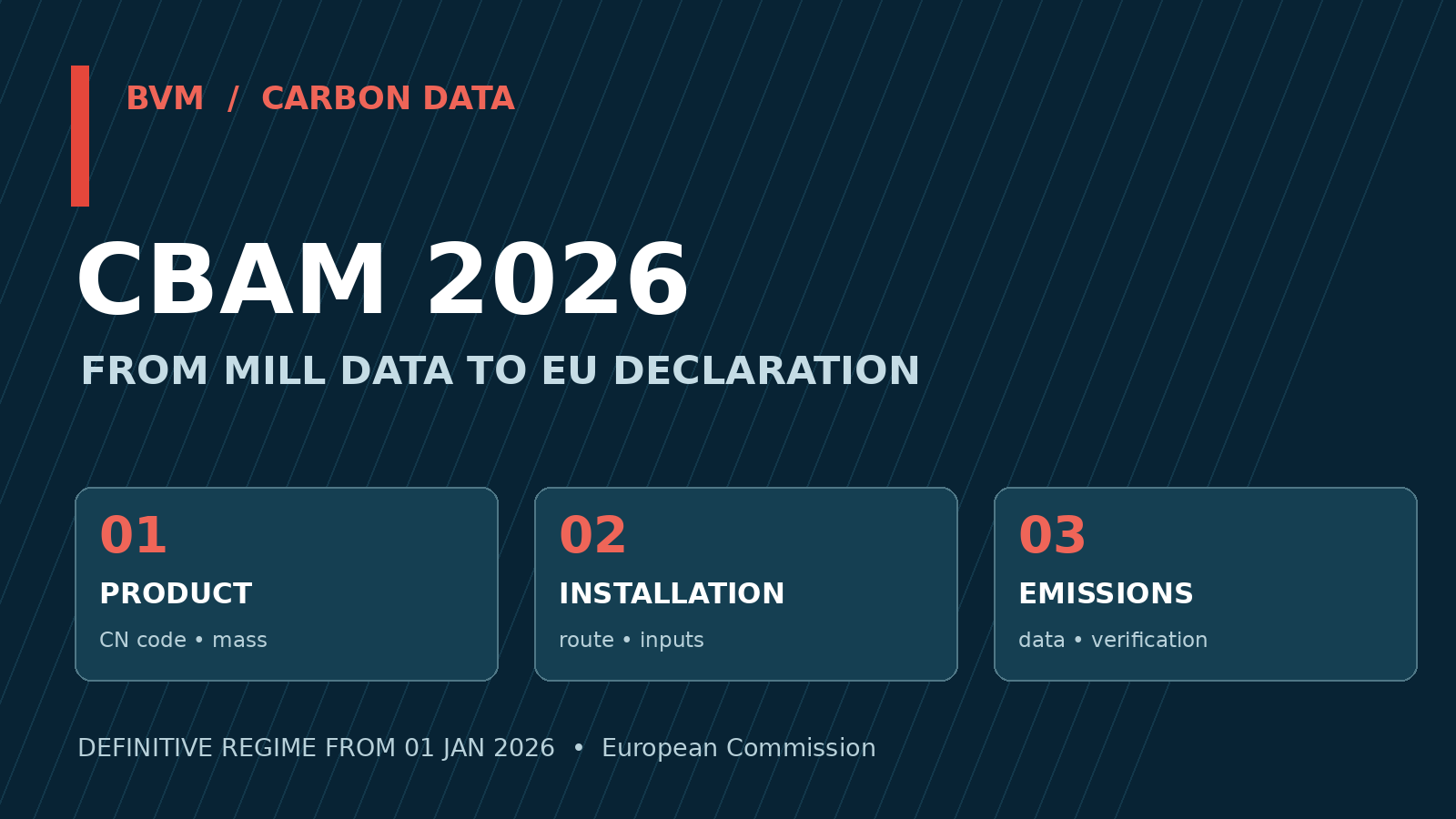
For a Vietnamese steel supplier, the practical work is to confirm product scope and organise data from the producing installation. BVM's suggested data chain links the product and CN code, installation and production route, activity and emissions data, and an audit trail showing sources, owners and reporting periods. This is a document-management framework, not an official EU template.
An MTC, country of origin and melt-and-pour statement serve different traceability purposes; none of them alone establishes CBAM embedded emissions. Where actual values are used, declared emissions are subject to EU verification principles. See the sector resources and verification regulation. Contract terms should identify who supplies data, the reporting period, delivery deadline and correction process.